
LEGO Graffiti: How to Make Street Art Look Real at Brick Scale
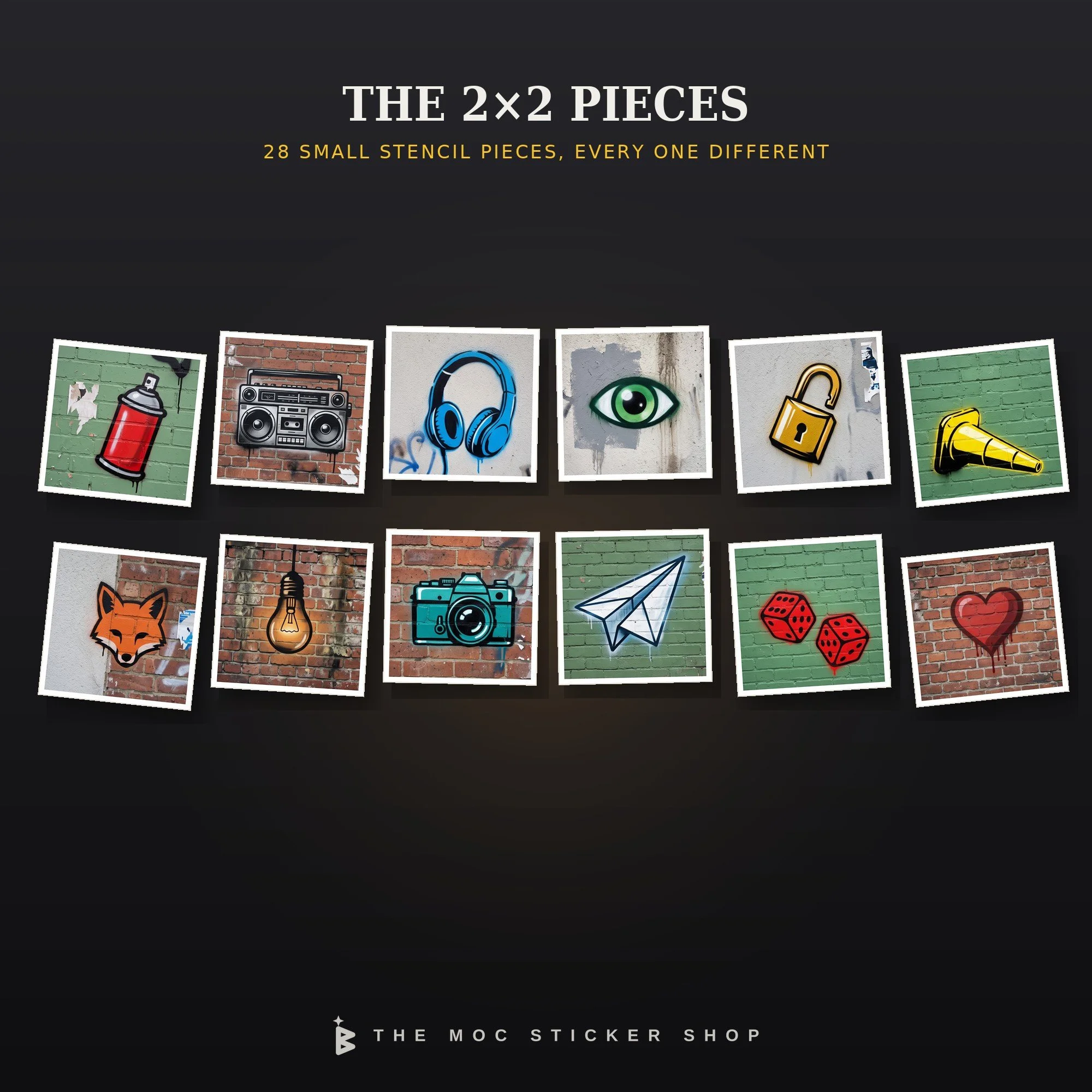
LEGO graffiti is easy to get wrong. The usual attempt is a bright cartoon on a clean tile, and it looks exactly like what it is: a picture stuck to a brick. Real street art is never just the picture. It is the paint and the wall together, and that is the part to get right.
The wall matters more than the picture
We found this out making our own street art sheet. The first attempts were flat colour on a flat background, and every one of them died on the tile. What carries a piece at fifteen millimetres is everything around it: brick courses, mortar lines, a scrubbed-out patch, overspray drifting past the edge and a run where the paint went on too thick. None of that is the subject. All of it is why the subject looks sprayed rather than printed.
One artist, not fifty
A city covered in graffiti from fifty different hands looks like a sticker book. Pick one style and hold it. Stencil work is the easiest to keep consistent at this scale: a black shadow layer, one bright colour and a white highlight, with no heavy outline. Across a whole layout that reads as one person working the city at night, which is a far better story than a random collection.
Paint what belongs on the street
Subjects should come from the street itself: pigeons, foxes, a crow, a spray can, a CCTV camera, a traffic cone, a boombox. City things and city animals. A jungle scene on an alley wall reads as a sticker, because nobody standing in that alley would have painted it.
Where LEGO graffiti goes: walls, shutters and trains
A LEGO graffiti wall works best as a run of separate pieces rather than one big mural, because real walls are painted a piece at a time over years. Shutters, hoardings and bin stores take the bigger pieces. Train carriages are the other obvious canvas: a 2x4 tile along the side of a carriage is exactly the shape of a piece on a real train, and it is the one place a moving model is expected to carry paint.
If your scene is a back street, our guide to the LEGO alleyway MOC covers where the doors, shutters and bins go before any paint arrives.
Size it so it reads
On our own sheet we made 2x2 the smallest size, because below that the layers that make a stencil read start to disappear at arm's length. Mix the sizes instead: one 4x4 as the centrepiece, a couple of 2x4s and 2x3s, and small 2x2 pieces scattered low, the way tags collect around a bigger piece.
Our Street Art & Graffiti sticker sheet has 54 stencil pieces on one A4 sheet, each painted onto its own wall and all in one consistent hand. You cut them out yourself. And if your city has its own crew name or a tag of its own, that is what custom LEGO stickers are for.
