
What Goes Inside a Spaceship Cockpit
You have built the hull. The engines look right, the canopy closes, and the whole thing has that lean look you were after. Then you open it up and the inside is bare studs and a chair.
Cockpit interiors are the part almost everyone leaves until last, and the part that decides whether a photograph of your ship looks like a model or looks like a place. The good news is that it is not really a building problem. A convincing flight deck is mostly a surface problem, and surfaces are solvable with flat tiles.
The one decision that makes a cockpit read
Before anything else, decide which century you are in, because the two answers look nothing alike.
A modern or far future cockpit is made of screens. Glowing readouts on near black, thin bright lines, one big display showing something outside the ship. A 1960s cockpit is made of instruments. Dials, tape meters, rows of switches, black faces on a light grey panel, and screw heads everywhere.
This is where most cockpit interiors go wrong. Builders reach for the idea of a control panel and end up with a muddle of both, and the result reads as generic sci-fi rather than as a real place. Pick one and be strict about it. The era is not a colour scheme, it is a decision about what the instruments actually are.
What is actually on the wall
Real flight decks are surprisingly repetitive, and that is the useful part. Almost every panel is built from a handful of elements, arranged with a clear hierarchy.
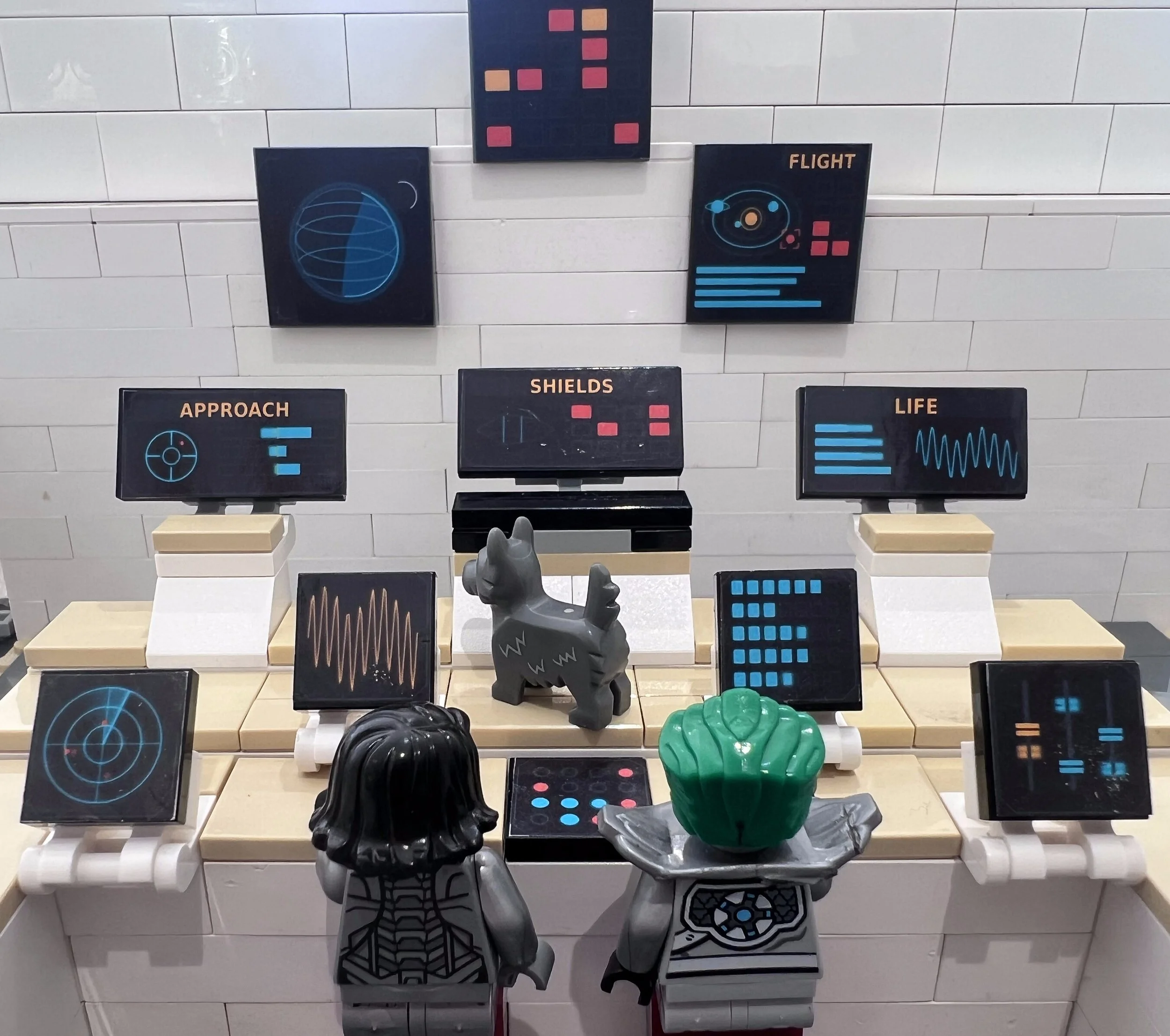
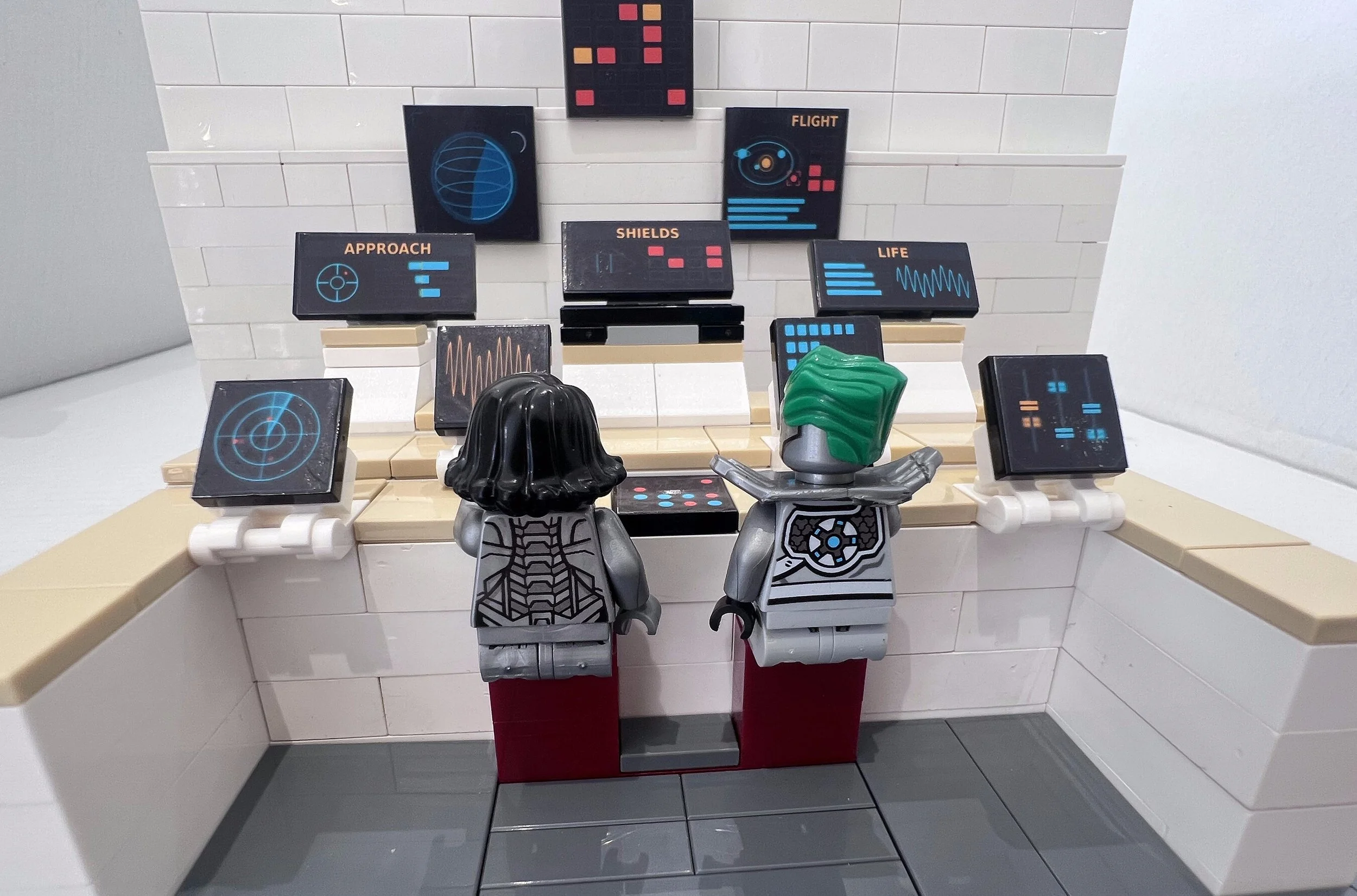
One hero display. A 4x4 tile is about the size of a main screen at minifig scale. Give it something worth looking at: a planet seen through a window, a master flight display, a caution and warning array.
Two or three consoles. 2x4 tiles read as individual stations. Navigation, life support, reactor, docking, approach.
A scattering of small system tiles. 2x2 tiles carrying a single gauge, a lamp cluster, an airlock hatch. These are the filler that makes a wall look busy without making it noisy.
Rails and placards. 1x4 strips run along the bottom of a console. 1x2 tiles name compartments: OXYGEN, AIRLOCK, MED BAY, HANGAR.
Get that proportion right and the wall reads instantly. One big thing, a few medium things, a lot of small things. It is the same reason a few small details is what sells a whole scene.
What the real hardware taught us
When we drew the retro half of our own range we started from photographs of genuine Apollo panels, and four details changed everything we thought we knew.
Grouping boxes are the signature. Nearly every control on a real panel sits inside a thin outlined rectangle, with the group name on a small tab that breaks the top line. Nothing floats loose on the panel.
The instrument faces are black and the panel is light. Get that the wrong way round and your spacecraft quietly turns into a car dashboard.
Tape meters, not round dials. The generic idea of a gauge is a circle with a needle, but real spacecraft mostly use vertical strip gauges with a pointer running up the side. Four round dials in a row is the fastest way to make a panel look invented.
And switches name both of their states. OPEN above the toggle, CLOSE below it, so you can read the whole panel at a glance without knowing the system.
Our favourite detail sits on the guidance computer. It has two small windows labelled VERB and NOUN, because the Apollo computer was commanded in a two word language: a two digit verb saying what to do, and a two digit noun saying what to do it to. Verb 06 Noun 62 asks it to display your velocity. It looks like a printing error until you know what it is, and then it is the best thing on the panel.
Leave most of the words off
The temptation with a control panel is to label everything on it. Resist that. The navigator does not need a word to tell him what a gauge does, and a wall of tiny text reads as clutter at any size smaller than a photograph.
Words earn their place in two situations: naming a place, and warning you about something. CAUTION on a warning array is a word doing a job. SCANNER written across a screen that obviously shows a scan is not.
Fitting one out
Our own Deep Space Edition sheet is built exactly this way: a planet through a viewport, a master flight display, twelve consoles and a row of wordless system tiles, all screens rather than dials, because that is what a modern cockpit is.
It is an A4 sheet of 66 designs on white vinyl, drawn entirely in code rather than generated, and you cut them out yourself. Put the big one on the back wall, a console either side of the pilot, and a few small gauges wherever the wall looks empty.
Then take a photograph of it, and see whether it still looks like a model.
